

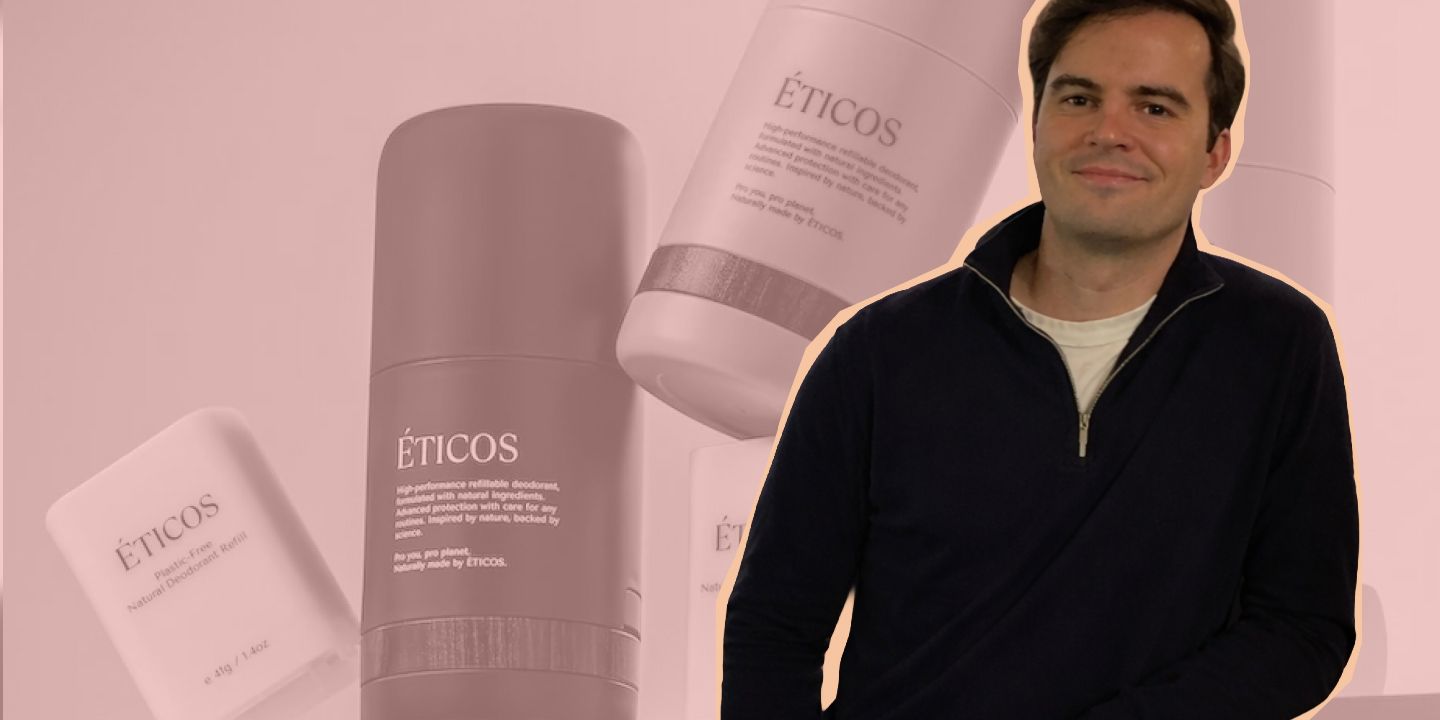
Rick Budel, founder and CEO of prestige refillable deodorant brand ÉTICOS, isn't optimising for the cheapest customer to acquire. He's optimising for the one who stays the longest.
In a conversation with The Checkout, Rick explained why he's built ÉTICOS around customer lifetime value from day one, how the refill model makes retention structural rather than aspirational, and why he doesn't consider Unilever or L'Oréal to be competitors.
The refill model as a CLTV engine
ÉTICOS sells a refillable deodorant where the only compatible refills are ÉTICOS's own. That's a structural lock-in that most DTC brands don't have.
"Of course the refill model is excellent for repeat purchase and higher CLTV," Rick said. "Especially our product, since the only refill that can be used in our products are from ÉTICOS."
On top of the refill mechanic, Rick pointed to category dynamics working in the brand's favour. Prestige beauty and personal care, and deodorant specifically, tend to produce high customer loyalty. People use the same deodorant for years.
"Combine this with a bespoke refill product and you optimise for a big CLTV," he said. "I believe brands should look at their business model like this, in order to eventually build a profitable and healthy company."
CLTV over CAC
Rick's thesis is that as ÉTICOS scales across multiple channels, markets, and products, the metric that matters most is not customer acquisition cost but customer lifetime value.
Join European founders, operators, and investors who read The Checkout every week.
"CLTV is where the money is made," he said.
The brand is still early in building out the data infrastructure to support this. Rick said the team is learning as it goes, talking to customers, understanding what drives repeat purchases and what causes churn.
"See what works, double down on it. Figure out what is broken: fix the problem," he said.
Growth with guardrails
Rick's retention-first approach shapes how ÉTICOS thinks about acquisition too. The brand is willing to invest heavily in acquiring customers upfront, as long as the unit economics work by the second transaction.
"There needs to be a plan to break even and become profitable on unit economics after the second transaction and there needs to be a CLTV plan in place," he said. "These are fundamentals of sustainable and healthy growth."
He stressed the importance of controllable growth, particularly for a CPG brand where supply chain infrastructure needs to keep pace. And he flagged something founders sometimes overlook when raising capital: protecting the cap table. "Something that some founders sometimes forget to carefully structure," he said.
Why retention is the moat
Rick isn't focused on who ÉTICOS is competing against category incumbents for shelf space or ad impressions. He's focused on what keeps customers coming back.
"What drives CLTV? It's customer satisfaction, loyalty, and connection with the brand," he said. "If you build something that people love, build a connection with your customers, create something that is hard to replicate, you can win from the big boys."
More on the brand is available at eticos.care.
AUTHOR
CONTRIBUTOR
SUPPORTED BY PAPER RUN

Paper Run helps brands win back customers that email can't reach through automated direct mail that integrates with Shopify & Klaviyo.
SUPPORTED BY WAYFLYER

Wayflyer provides purpose-built financing to consumer brands worldwide, deploying over $6 billion to 7,000+ businesses since launching in 2020.
SUPPORTED BY RIVERFLOW

Riverflow is the leading creative AI platform for CPG and Fashion brands, built specifically for high quality, brand accurate visuals in both photoshoots, static ads and videos.
SUPPORTED BY VINE TALENT

Josh at Vine Talent provides consultative executive search for ambitious European consumer brands, helping founders access the calibre of international talent needed to unlock their next stage of growth.
JOIN OUR FOUNDER NETWORK:

VENICE FOUNDERS NETWORK
Where 200+ European consumer founders solve problems together.
An independent space for Europe's Consumer Founders & CEO's.